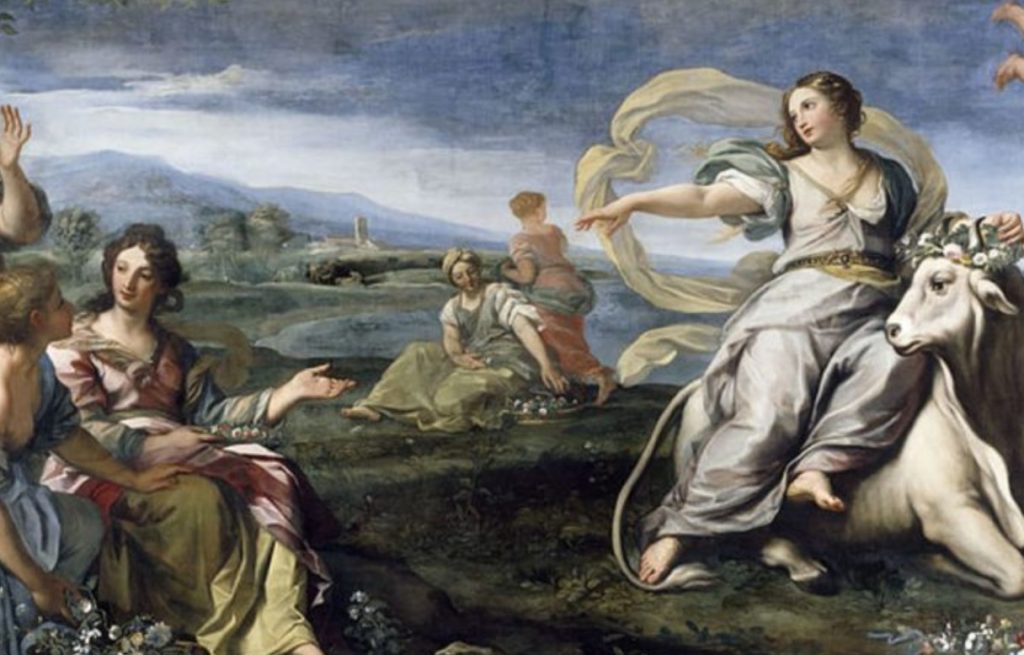
The discovery of Thassos is linked to a famous tale of ancient Greece. Long ago, King Agenor ruled eastern Phoenicia. He had three sons: Phoenix, Cilix, and Cadmus and one daughter, Europa.
One spring day, Zeus transformed into a bull and kidnapped Europa. He carried her to the Dictaean Cave in Crete. There, Zeus coupled with her in the form of an eagle. This union produced three sons:
Sarpedon: The first king of Lycia.
Minos: The famous king of Crete.
Rhadamanthys: The wise lawgiver.
While Europa was hidden, King Agenor ordered his family to find her. He gave them a strict command: do not return without her.
Phoenix set out towards the south. Cilix went north until he reached a fertile land where he made himself king: since then it has been known as Cilicia. After wandering through the Greek islands, Cadmus continued his search in mainland Greece. He visited the oracle of Apollo at Delphi and consulted Pythia the priestess. Although he followed her advice, he was unable to find Europa. After passing through Phocis he came to Boeotia, where he built an acropolis, Cadmeia, and below it a town with broad avenues, which he named Thebes.
Meanwhile, Thassos, Agenor’s grandson, searched for Europa in various places until he came to an island off Thrace. Captivated by its marvelous climate and lush vegetation and unable to return without Europa, he gave up his quest. He and his retinue settled on the island, which has borne his name ever since.
Because of its clear air and cool summer breezes, the ancient poets gave the island other names, such as Aeria or Heeria. This name was also mentioned in the Delphic oracle received by the leader of the Parian colonists, Telesicles (680 BC): “Don’t tell the Parians, Telesicles, that I have ordered you to build on the isle of Aeria a city that will be visible from all around. It was also called Aethria, meaning “clear blue sky”, and Chrysia, a reference to the lustrous gleam of the gold (chrysos) once mined there.
The religious belief of the Thasians, as of all the ancient Greeks, was centered on the twelve gods of Olympus. However, the island’s patron was Heracles, a mystical god who may have had his origins not in the Greek half-god Heracles (Hercules), but in the Phoenician god Melkarth. Special honors were reserved for the god of the sea Poseidon and the goddess of the hunt Artemis.
The mysteries of Demeter, brought to Thassos by the Parian priestess Cleobia, were celebrated. There were also special feasts of Pythian Apollo, whose snowy white temple sparkled on the acropolis above the city.